Know every AI agent.
Gate every action.
Damn discovers and connects the agents already running across your company, gives each one an owner and a boundary, gates what it can reach and spend, and keeps the record on your infrastructure.
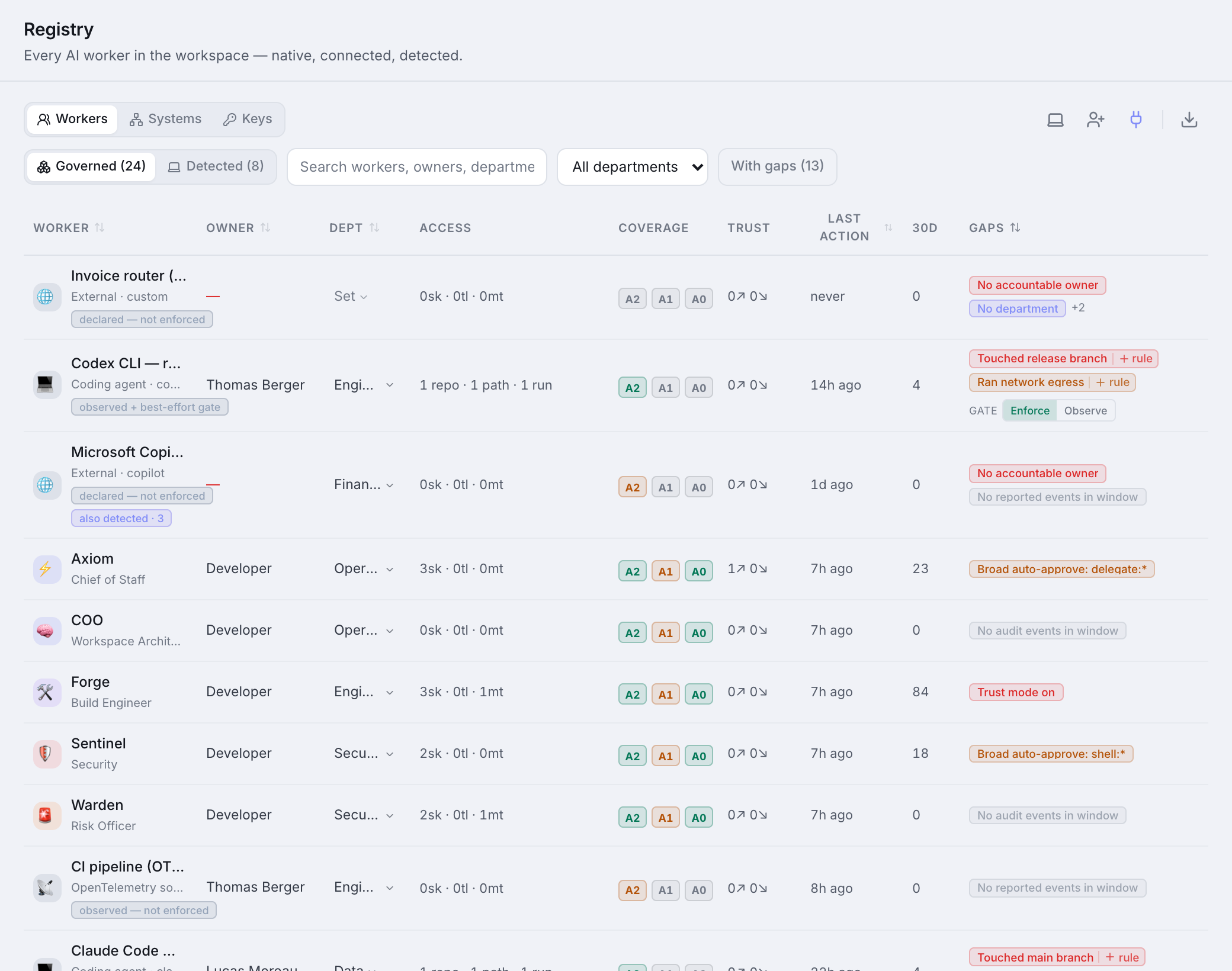
Governs the AI your teams already run
Every agent creates the same five questions.
Claude Code on a laptop. A vendor agent inside a SaaS product. An experiment a new hire installed on Tuesday. Each arrives with its own credentials, logs, and approval model.
If nobody can answer, the agent is operating on trust.
The mechanism
Govern at the keys and the doors.
You do not need to move every agent onto one platform. When an agent reaches a real system, it crosses a credential, a network destination, an execution boundary, or a file path. Damn applies policy there.
Doors
EverywhereWhere control lands when the resource is yours: your systems, your network, your files.
Keys
Where issuableStronger where we can issue the credential. Scope it, cap what it spends, revoke it once.
The box
EnterpriseFor agents nobody is watching. Cron, CI, anything unattended runs inside a boundary we provide.
Any agent. Any model. Any runtime. No gateway in front of your traffic, and no routing through anyone's cloud.
Built here
Ops agents
Finance · Support · Legal
Connected
Coding agents
Claude Code · Cursor · Codex
Connected
External agents
Vendor & SaaS agents
Your infrastructure
One control layer
Keys · Doors · Files
Allow · Ask · Deny
Your systems & data
APIs · Repos · Databases
Where this sits
Your stack governs people and machines. Agents are neither.
Damn does an agent-native version of every layer you already run, and the one nothing covers today.
Where you already run a corporate network chokepoint, enforcement rides it rather than replacing it.
It is also the only layer that produces the evidence you will eventually be asked for.
One boundary for every team.
The proof stays with you.
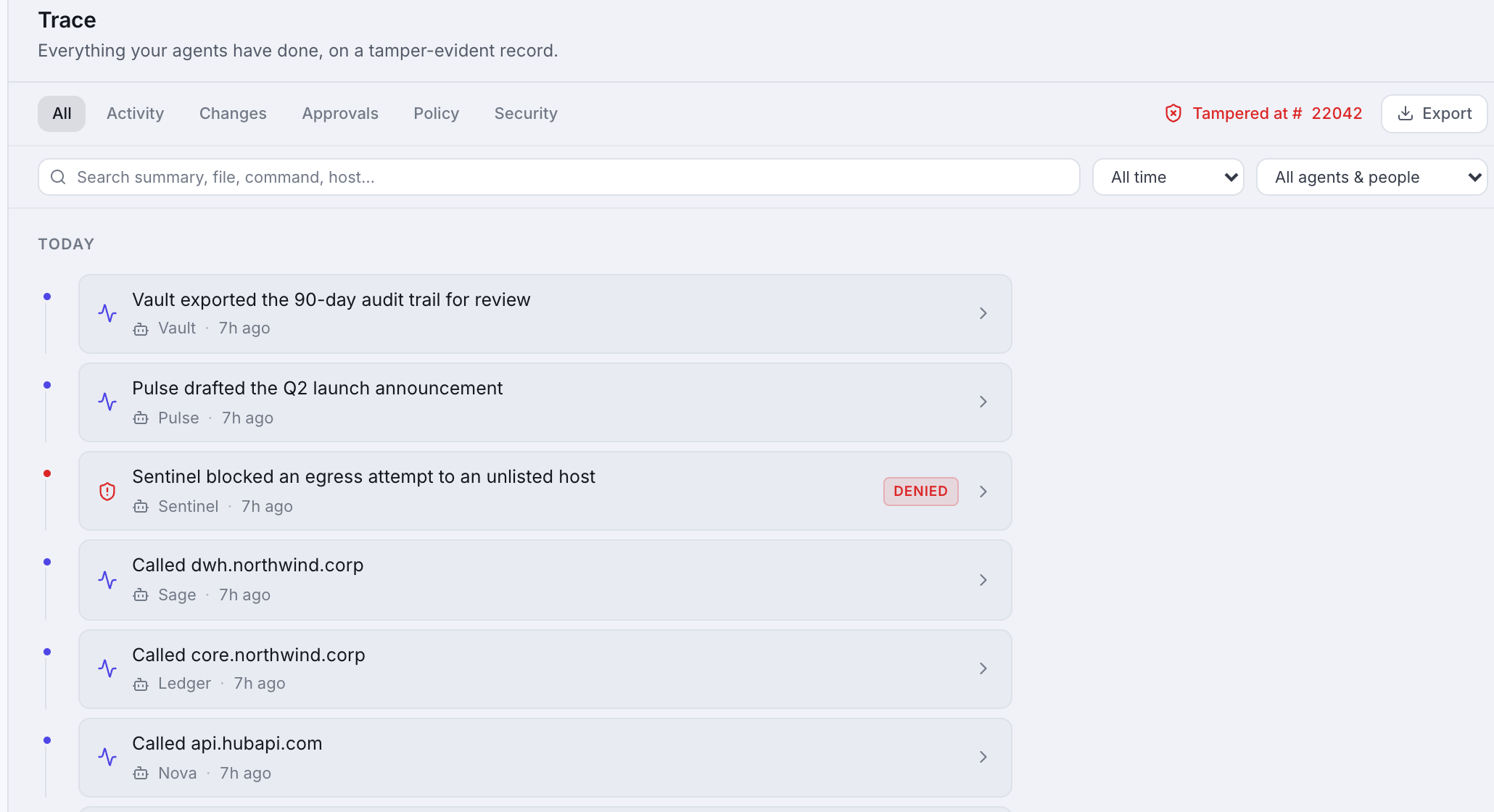
Every action and policy decision lands on a hash-chained record on your infrastructure. Change a past entry and the chain no longer verifies.
By default, Damn governs access without reading prompts, code, or business data. If you enable content inspection, it runs inside your environment behind your own certificate authority. Content does not reach Damn.
Your teams are already using AI.
Give every agent an owner, a boundary, and a record before the next one reaches production.
FAQ
Governance and observation are free to self-host on your own machine or server. Install it and see what your agents are doing at no charge. Running your own agents on the platform needs a license. Managed hosting and Studio are paid options for people who want it run, or built, for them.
On your infrastructure. Nothing leaves it. With managed hosting it runs on a dedicated VPS where you are the sole admin; we never access your workspace without your explicit, time-boxed consent.
No. Observability is a camera: it tells you what happened, after the fact. Damn is a lock plus a notarized logbook: it stops what shouldn’t happen and proves the rest. You set the rules agents act under, risky actions wait for a human, and every decision lands in a tamper-evident record you can export.
Those govern access: which credentials an agent holds and what it is allowed to reach. Damn governs the action: what the agent actually does with that access, the moment it acts. A password tool is a key card that decides which doors open; damn.dev is the guard in the room that can approve, deny, or gate what happens once the agent is inside, and records every action on your own infrastructure. They are not rivals: identity hands the agent a key, damn.dev governs what it does with it. You will likely want both.
Every agent has a named owner and a department, an explicit boundary of what it can access, and a tamper-evident record of everything it does. No agent runs anonymously.
Yes. A connector captures what Claude Code, Cursor, Devin, or Codex did into the same registry and audit trail as the rest of your workforce: who ran what, where, when. Observed, not enforced: policy enforcement over external coding agents is on the roadmap, and we’d rather say so than overclaim. (Claude Code also appears as a runtime above. That’s different: an agent you build in Damn using it as its engine, fully governed like any native agent.)